


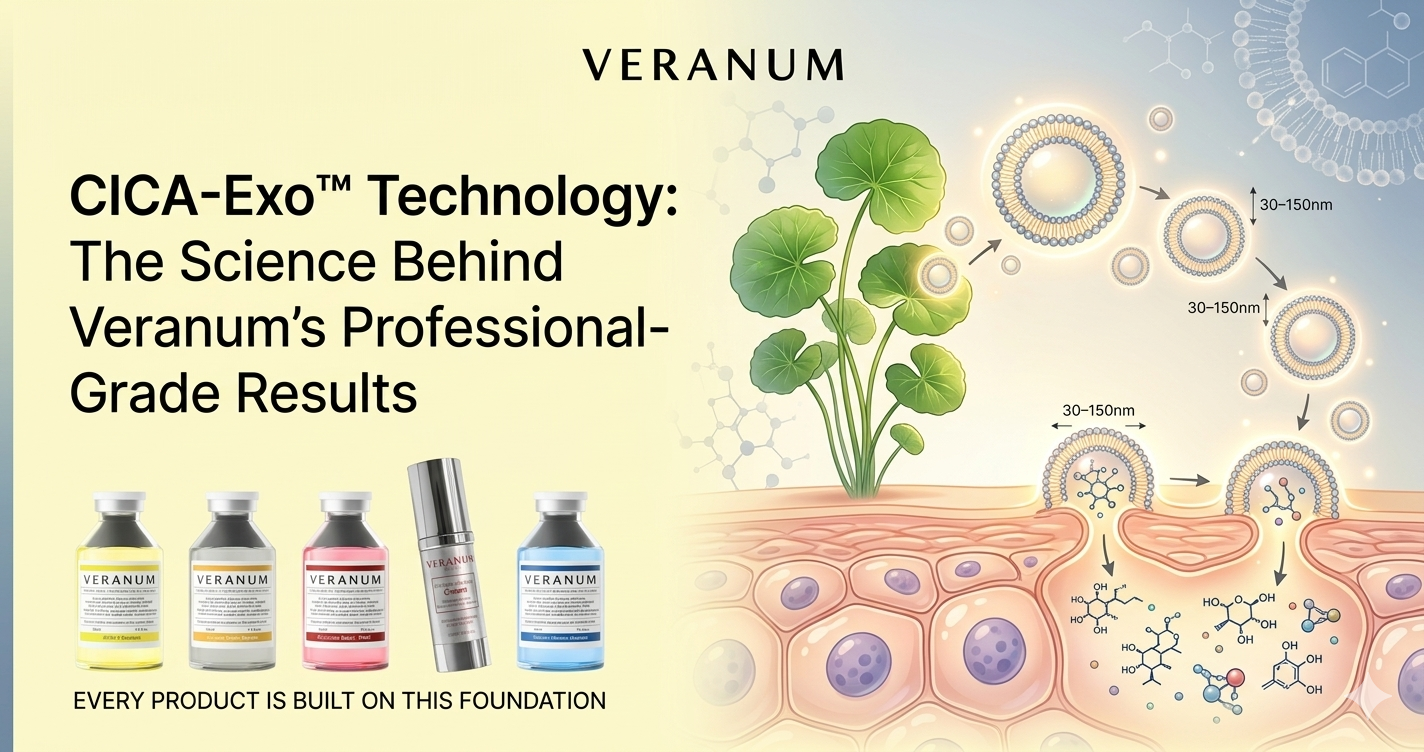
Most skincare ingredients are new — synthesized in a lab within the last two decades, stabilized within the last five years, marketed within the last six months. Centella asiatica is not one of them. It's a small flowering herb that's been central to three traditional medicine systems for over two thousand years, and the reason it sits at the foundation of every Veranum formula isn't because it's trendy. It's because the heritage predicted the chemistry. This is the long story of cica.
The plant before the ingredient
Centella asiatica grows low and wet — creeping along rice paddies, wetlands, and stream banks across tropical and subtropical Asia, Africa, and Australasia. Its leaves are small, kidney-shaped, serrated at the edges. If you've seen it in a Seoul farmers' market, in an Ayurvedic pharmacy in Kerala, or growing wild in Madagascar, it's the same plant with different names.
English speakers know it as gotu kola (from Sanskrit), Indian pennywort, tiger grass, or simply cica (a shortening of the Latin genus). In Korean skincare it's "호랑이풀" — tiger grass — because of a piece of folklore that turned out to be half field observation and half origin myth.
The tiger story
The Korean folklore goes that wounded tigers would roll in centella patches to heal their injuries. It's the kind of origin story you'd expect to be marketing decoration. Field biologists in Bengal and Southeast Asia have actually documented wild tigers rolling in centella and similar herbs after territorial fights — less "applied dermatology" and more "wound-covering behavior," but enough to make the name not entirely fanciful.
What the tigers may or may not have been doing matters less than what Korean herbalists, Ayurvedic practitioners, and traditional Chinese medicine doctors were doing with the same plant two millennia earlier: treating burns, wounds, skin conditions, and post-surgical recovery. That convergence — three independent medical traditions, on three continents, reaching for the same plant for the same purposes — is usually a clue that the chemistry is real.
From traditional medicine to modern pharmacology
The bridge between centella-as-folklore and centella-as-skincare-active runs through French dermatology in the 1940s and 1950s. Researchers at Laboratoires Servier isolated and standardized four active triterpenes from the plant — asiatic acid, madecassic acid, asiaticoside, and madecassoside — and published a series of papers showing clinically meaningful wound-healing acceleration. The resulting standardized extract, called TECA (Titrated Extract of Centella Asiatica), became a pharmaceutical-grade active used in hospitals for post-burn care and post-surgical recovery.
By the 1970s, Korean dermatology had adopted the extract for aesthetic and clinical skin applications. By the 2000s, it was showing up in K-beauty consumer products. By 2020, it was the most-studied plant active in commercial skincare. The progression wasn't accidental — each step was driven by the accumulating evidence that madecassoside in particular had effects far beyond what a botanical extract usually delivers.
Why Veranum built around it
Three reasons, in order of how we think about them.
The chemistry is honest. Plenty of skincare ingredients are marketed on botanical heritage while delivering almost no active chemistry. Centella is the opposite — the heritage correctly predicted the chemistry, and the chemistry outperforms most synthetic alternatives for barrier repair, inflammation suppression, and tissue remodeling. Building a line around it means building a line on evidence rather than claims.
It plays well with everything. Centella doesn't compete with other actives. It doesn't disrupt vitamin C's pH. It doesn't interfere with retinoids. It doesn't require special storage or layering rules. It amplifies the effect of almost every other active you put it near. For a skincare line trying to produce compounding results across a routine, that matters.
It respects the barrier. The first rule of modern skincare — especially after 40 — is "don't damage the barrier faster than you rebuild it." Centella is one of the few actives whose side effect is barrier rebuild. Every step you take with centella in the formulation is a step forward, not a step you have to pay back later.

What we mean when we say "foundation"
In the Veranum line, "foundation" is literal. The CICA-Exo-delivered TECA complex isn't a feature ingredient in one product and absent from the others — it's the substrate every formula is built on. The headline active changes from product to product (hyaluronic acid in Cicaultra, guaiazulene in Cicazulene, L-ascorbic acid in Active C), but the centella base is consistent.
That consistency is the brand promise, not just a formulation detail. If you're using any Veranum product, you're getting the two-thousand-year-old signal that plays well with everything else in your routine and rewards consistency across weeks.
The short version
Centella asiatica is an ancient plant that modern dermatology happened to confirm. It's the foundation of every Veranum formula because the heritage correctly predicted the chemistry, the chemistry outperforms most alternatives, and the ingredient respects the barrier instead of degrading it. Every time we formulate something new, we start from the same place — because the tigers were onto something, and the herbalists knew it two millennia before the French dermatologists did.
Start with the centella foundation
Every Veranum product carries the same centella base. Pick the one that matches your primary concern.

